Banned Books Week 2026
Celebrate FREADom - Read a banned book
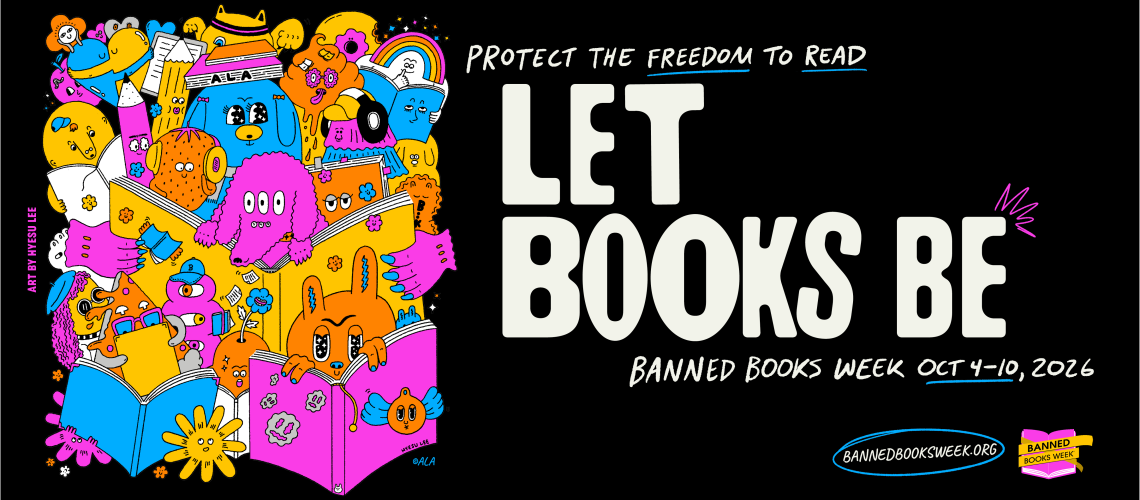
Banned Books Week
What Is It?
Banned Books Week was started in 1982 by Squirrel Hill native
Judith “Judy” Fingeret Krug, a Pitt undergrad alumnus with a Masters in Library Sciences from the University of Chicago. She devoted her life’s work to intellectual freedom and censorship-free reading. This advocacy began during her tenure as the director of the American Library Association’s (ALA) Office of Intellectual Freedom (OIF) and continued into her executive directorship of the Freedom to Read Foundation. She founded Banned Books Week to continue this work and bring national attention to the harmful effects of censorship.
More than 40 years later,
this event brings together librarians, educators, publishers, booksellers, authors, and readers from all walks of life to fight for the right to open access to information and freedom of expression. These freedoms are the most basic components of a strong democracy because they encourage people’s self-discovery, curiosity, access to knowledge to sate that curiosity, creativity, and critical thinking when it comes to decision-making in the social, economic, and political arenas.
The Hows and Whys of Book Censorship
You may ask “Why are some books banned?” or “How bad is this problem, really?”
The answers to these questions come from the
ALA’s tracking system for reported bannings and censorship attempts. But even the following statistics are not all-encompassing because not all censorship is reported.
2023: 4,240 unique titles challenged
2025:
4,235 unique titles challenged
1,671 of these (40%) depict some aspect of the lived experiences of people in the LGBTQIA+ and BIPOC communities
5,668 books banned from libraries
920 books censored through access restrictions
Highest # of challenges in one year AND highest number of conversions from challenge to censorship since 1990!
Also according to the ALA, pressure groups, government officials, and other decision makers initiate 92% of challenges, many of which fall into these categories:
False claims of “obscenity” or “harm to minors” (more on the definition of these legal terms below)
LGBTQIA+ character or theme inclusion
Topics of race, racism, equity, and social justice included
Now if, like I did, you’re wondering what “obscenity” and “harm to minors” actually mean, here’s a short summary of a very good
lecture and Q&A with Ben Cover, an associate professor of law at the University of Idaho.
To build context, he begins by differentiating between different interpretations of the U.S. Constitution. There is a literal reading, popular understanding, and constitutional doctrine. The third option is what he digs into because it is determined by the precedents and decisions handed down by the U.S. Supreme Court (SCOTUS). He then explains the constitutional doctrine that has evolved around the concept of free speech within the context of the first amendment. The most important thing to note is that all levels of government (federal, state, and local) do not have the right to impinge on protected categories of free speech. If proven to be obscene for minors, harmful to minors, or containing child pornography, media materials fall into the unprotected forms of speech grouping.
How obscenity and harm to minors are determined come from two court cases:
Miller vs. California (1973) and
Ginsberg v. New York (1968). The resulting Miller-Ginsberg Test has three conditions, ALL of which must be met when considering the work as a whole in the eyes of the average adult applying contemporary community standards. The first condition is that the work appeals to the prurient interest of minors which is defined as the shameful or morbid interest in nudity, sex, or excretion. The second condition is that the work’s depictions of sexual content are “patently offensive” as defined by applicable state law.
While these first two conditions are thought to be subject to a jury’s decision on a case-by-case basis, even by SCOTUS, the third condition is said to be something that can be reasonably determined outside of the courtroom. This condition is as follows: the work lacks serious literary, artistic, political, or scientific value for minors. As an example, a high school anatomy textbook is not obscene or harmful because its depictions have scientific and educational value.
In 1988, when the American Bookseller’s Association challenged a Virginia statute that banned the commercial display (where juveniles might see) of media that “depicts sexually explicit nudity, sexual conduct or sadomasochistic abuse and which is harmful to juveniles.” They did this because they did not want to get in trouble for violating a rule that could potentially apply to between 5% and 25% of their inventory. The case went all the way to SCOTUS, but instead of ruling on it, the Supreme Court asked the Virginia courts to clarify a few things like age categories of juveniles, etc.
The Virginia courts eventually came back with the following statement: “If a work is found to have a serious literary, artistic, political or scientific value for a legitimate minority of normal, older adolescents, then it cannot be said to lack such value for the entire class of juveniles taken as a whole.” When SCOTUS acknowledged this statement without an opposing ruling, it set the precedent for many states to have exceptions written into their laws regarding distribution of harmful media to minors for public libraries and other educators. These exceptions protect public libraries and educators from prosecution for distribution of materials to minors of materials publicly available to and not considered obscene for adults in these spaces. They cannot be expected to vet every request from a potentially underage person for every
possibly
inappropriate book.
Now, if you’ve read all this information and are still asking “What does this mean for banning books, especially in libraries?” here is my answer. No level of government can legally tell a public library to ban a book based on LGBTQIA+ characters or racial justice themes and similar controversial topics because those materials are relevant to the lived experience of a big legitimate minority of adolescents
and
adults in this country. And the materials have literary, artistic, political, and scientific value.
Please enjoy reading and writing materials that speak to you and have value to the community. Read a book like
Tricks
by Ellen Hopkins or
The Perks of Being a Wallflower
by Stephen Chbosky. Support Banned Books Week and the freedom of expression and open access to information that it puts into action.
Local and Regional Ties:
Monroeville
The municipal government of Monroeville forced the public library there to take its Pride Month display down a week early. Details on who in the council initiated this action and why the library and its own autonomous board acquiesced are unclear, but Sue Kerr of PGHLesbian Correspondents had this to say:
“The other significant issue is the perpetuation that any book or library material with LGBTQ+ content or themes is dangerous – it promotes a lifestyle, overrules parental authority over exposure, promotes sex, and is surely tied to grooming. These are horrible stereotypes that plague every LGBTQ+ person.”
Lawrence County
The New Castle Public Library became embroiled in a controversy after a local political candidate from the conservative Constitution Party “publicly expressed opposition to [its] LGBTQ+ inclusion efforts” (Van Ness, 2026). Tensions between him and the library’s openly gay director, increasingly strained relationships between its board and New Castle Prism Initiative founder Trevor Preisel, and litigation involving the director led to the cutting of all LGBTQIA+ library programming and the director’s resignation.
Lancaster County
The borough council of Akron, PA in Lancaster County voted to defund the county library after 30 years of support because of two members’ “discomfort” over a women’s health class that the library hosted, citing misalignment between “sexual matters” and “conservative values.” Many community members and a few fellow council members decried this reasoning as ideology-based rather than having fiscal merit, but the decision stands.
Events:
Carnegie Library of Pittsburgh
“That Librarian” Banned Books Week Book Club
Sunday, October 4, 2026, 1:00 PM - 2:00 PM
CLP - Main (Oakland) 4400 Forbes Avenue, Pittsburgh
Main Zine Collective: Freedom to Read
Wednesday, October 7, 2026, 6:00 PM – 7:30 PM
CLP - Main (Oakland) 4400 Forbes Avenue, Pittsburgh
Adult Read Aloud: Banned Books
Thursday, October 8, 2026, 6:30 PM – 8:00 PM
CLP – Main (Oakland) 4400 Forbes Avenue, Pittsburgh
University of Pittsburgh- Oakland Campus
Study Break Tuesday Banned Books Week
Tuesday, October 6, 2026, 1:00 PM - 3:00 PM
Hillman Library- Ground Floor
3960 Forbes Avenue, Pittsburgh, PA 15260
Northland Public Library
Thursday, October 8, 2026, 6:00 PM - 7:30 PM
Northland Public Library
300 Cumberland Rd., Pittsburgh, PA 15237